
Publication: Understanding fracture mechanisms in NMC811 particles via stochastic anisotropic phase-field modelling
Mechanical degradation of secondary NMC811 particles is a key factor limiting the cycle life of lithium-ion batteries, as particle fracture isolates active material and disrupts lithium transport. This study presents a 2D stochastic anisotropic chemo-mechanical phase-field model to predict fracture evolution in NMC811 particles during electrochemical cycling. Material heterogeneity is modelled using a Weibull distribution of local tensile strengths, capturing variability from manufacturing-induced defects. The model couples anisotropic lithium diffusion, lattice strain, and mechanical damage, enabling realistic simulations of the particle's electrochemical–mechanical behaviour. Simulation results align with FIB tomography reconstruction observations, reproducing crack morphologies and validating the model's predictive accuracy. Parametric studies reveal that diffusion anisotropy has the greatest impact on damage evolution, while higher C-rates and larger particle sizes accelerate fragmentation. Cracks are shown to disrupt lithium transport, induce sharp concentration gradients, and reduce accessible lithium inventory. This framework provides a robust, physically grounded, and statistically informed approach for modelling the coupled chemo-mechanical behaviour of NMC811 particles. The findings offer valuable insights for optimizing electrode design and cycling strategies to improve the durability and performance of lithium-ion batteries.
Abstract from the publication. Read the full article here.
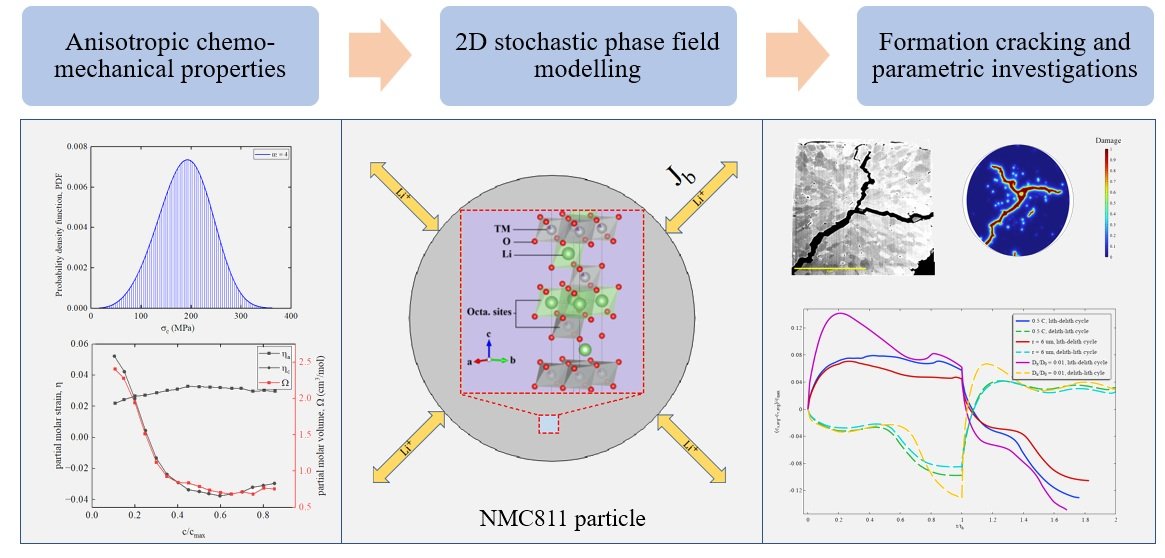 Graphical abstract