Publication: Electrochemical Impedance Spectroscopy Accuracy and Repeatability Analysis of 10 kWh Automotive Battery Module
For the publication on "Electrochemical Impedance Spectroscopy Accuracy and Repeatability Analysis of 10 kWh Automotive Battery Module" DigiCell partner Keysight teamed up with BMW group.
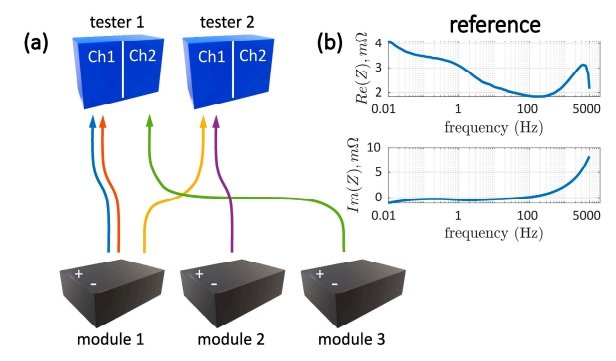
Electrochemical Impedance Spectroscopy (EIS) measurements are highly sensitive to the fixturing, temperature, and state of charge (SoC) of batteries. For 10 kWh automotive battery modules, they show that variations in SoC and temperature introduce significant errors at low-to-medium frequencies (<100 Hz), while improper fixture wiring affects mainly higher-frequency accuracy, with errors up to 100% in the imaginary part at 1 kHz. In addition, we they repeatability across various tester-module configurations. EIS results remain highly consistent (±100 μΩ) across three different modules. Comparing the same module across two different testers, deviations are even lower (±30 μΩ up to 1 kHz). The EIS evolution is studied with respect to the cycle numbers, where a strong correlation of low-frequency impedance features is demonstrated. A new combined quotient feature is introduced and suggested as a reliable and efficient state of health (SoH) indicator, solely based on a model-free and phenomenological approach. The study demonstrates the potential of EIS as a powerful tool for battery module characterization, provided that its requirements and limitations are carefully addressed through well-defined experimental setups. Accurate and repeatable EIS measurements are particularly important for obtainingaccurate electrochemical insights, especially in the low-to-mid frequency domain, where impedance variations are most sensitive to battery states and ageing effects.
Abstract from the publication. The full publication is available for download here.