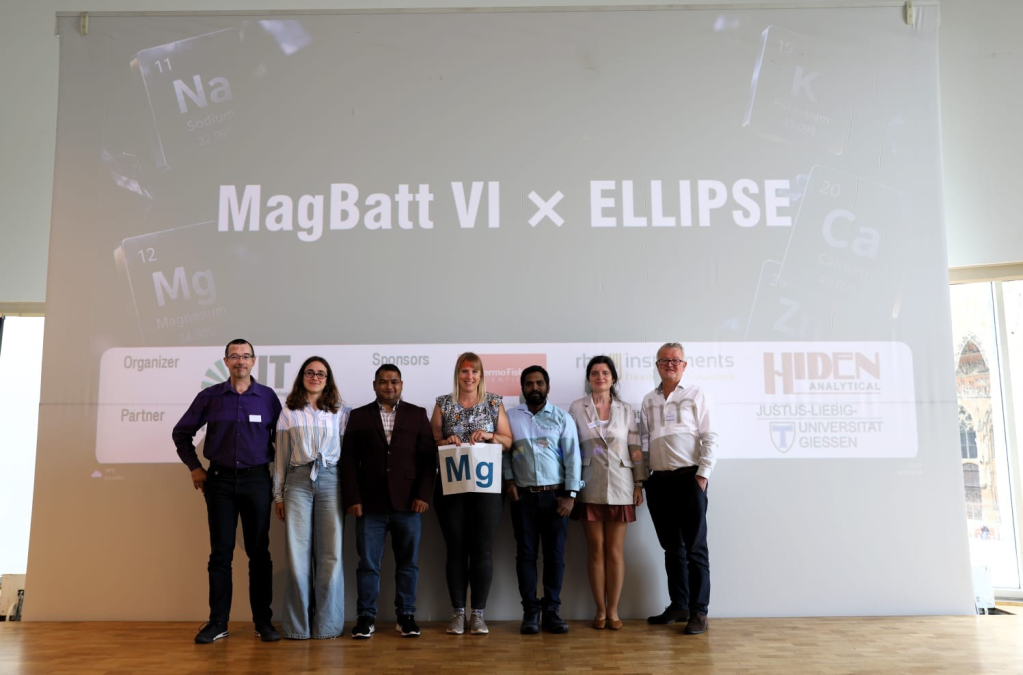
DigiCell presents magnesium battery research at MagBatt VI × ELLIPSE
From 9 to 11 September 2026, the MagBatt VI × ELLIPSE conference brought together international researchers in Ulm, Germany, to discuss post-lithium battery technologies. Irshad Mohammad from the Austrian Institute of Technology (AIT) presented the institute’s recent work in DigiCell relatedt o magnesium-metal batteries.
Surface-engineered magnesium foil enables reversible operation
In his presentation, “Surface-Engineered In-Coated Mg Foil Anode Enables Reversible Mg²⁺ Plating/Stripping in Conventional Mg(TFSI)₂ Electrolytes”, Irshad Mohammad described a strategy to address a long-standing problem with magnesium-metal anodes. Conventional Mg(TFSI)₂ electrolytes can create a passivating layer on the magnesium surface. Passivation blocks the movement of magnesium ions and prevents the battery from charging and discharging efficiently. To overcome this problem, the researchers created an artificial indium-based layer on magnesium foil. The layer mainly consists of indium and magnesium–indium phases. It helps prevent passivation while allowing Mg²⁺ ions to move across the interface. As a result, the In-coated magnesium foil enabled reversible magnesium plating and stripping in the conventional electrolyte. In simple terms, magnesium could be deposited onto and removed from the foil repeatedly, which is essential for a rechargeable battery. The In–Mg/Mg(TFSI)₂/Mo₆S₈ full cell delivered approximately 80 mAh/g over more than 100 cycles at C/5, with nearly 95% efficiency and excellent rate capability.
This work demonstrates a simple interfacial-engineering approach for improving magnesium-metal anodes. By using an In/MgIn artificial interphase to suppress passivation and support Mg²⁺ transport, the approach could enable reversible magnesium-metal anodes without relying exclusively on highly specialised electrolytes.
The MagBatt VI × ELLIPSE conference combined the International Symposium on Magnesium Batteries with the ELLIPSE Conference on electrolytes and interfaces in post-lithium batteries. Its programme covered magnesium, sodium, potassium, calcium, zinc and aluminium batteries, as well as advanced characterisation, modelling and electrochemical performance.